Project scope
Plan access and suspect-material assessment before roof-space work
Keep investigation needs separate from permission to enter or disturb.
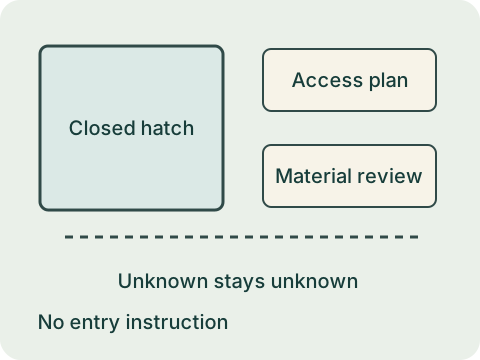
Do not treat access as a harmless prerequisite
A request for better photographs should not pressure a homeowner to enter a roof space or climb onto a roof. CCOHS describes roof-work hazards and task-specific planning needs. This portal gives no safe-height rule, walking route or instruction for using a roof surface.
Record the access known from documents or ordinary observations and ask the responsible party what assessment plan is needed. Confined geometry, surfaces, equipment and weather may affect that plan. The homeowner record is useful even when it states that an area has not been accessed.
Keep material identity unresolved until assessed
Health Canada advises avoiding disturbance of suspect asbestos-containing materials and arranging appropriate professional evaluation before work. NRCan also flags hazards in retrofit planning. Age and appearance can prompt a question but do not identify material composition.
Do not sample, move, cover or remove an unknown material because an online diagram appears simple. Ask the qualified party to explain what assessment is appropriate and which limitations or controls affect the proposed work. Keep any actual report with the project rather than replacing it with a general reassurance.
Include the assessment boundary in the proposal
Ask the proposal to identify access arrangements, assessment responsibilities and the process if suspect materials or unexpected conditions are found. Keep those items separate from ordinary product quantities. A quote for vent installation may not include every investigation or hazardous-material task.
Save the review findings and authorized scope before dependent work. No arithmetic result from the area or quote tool establishes a safe work method or clearance. The project brief should make unresolved access and material questions visible so the responsible parties can address them without generic homeowner disturbance advice.
A worked planning example
An attic hatch exists, but the homeowner has not entered the space and does not know the material identity. The record can state both facts. It should not translate an available hatch into permission to enter or a building date into an asbestos result.
Ask the responsible party how access and material questions will be resolved before disturbance. If an assessment report is supplied, preserve its actual scope, findings and limitations. A later installation quote should explain how those findings affect the work. This keeps the investigation useful and detailed without suggesting that a generic warning alone makes hazardous access or disturbance acceptable.
Keep in your brief
- No roof-access permission is provided.
- Appearance does not identify asbestos.
- Assessment and work scope need clear owners.
Primary references
- Residential roofing — CCOHS
Canada: occupational safety education; applicable law is jurisdiction-specific
- Fall protection: general information — CCOHS
Canada: occupational safety education
- Health risks of asbestos — Health Canada
Canada: health information
- Keeping the heat in, section 1: introduction — NRCan
Canada: energy-retrofit planning